Advancing Disability Inclusion in Egypt: From Global Commitment to National Action
Speech by the UN Resident Coordinator in Egypt.
Your excellency Margrite Saroufim.
Dr. Iman Karim,
Colleagues,
Ladies and gentlemen,
Good afternoon.
It is a genuine pleasure to welcome you to this workshop on advancing disability inclusion in Egypt, held on the margins of the International Day of Persons with Disabilities.
Being here with so many dedicated partners remind us that progress in this area is both possible and deeply meaningful.
Allow me to begin by acknowledging the strong leadership shown across the Government of Egypt — from the highest political level to the Ministry of Social Solidarity, the National Council for Persons with Disabilities, the Ata’a Fund, the Differently Abled Fund, and all partners whose collaboration turns commitments into real improvements in people’s lives.
Your dedication is the driving force behind today’s conversation.
For far too long, disability worldwide was viewed through a narrow lens — one focused on charity or medical needs, approaches that attempted to “fix the person” or simply extend assistance.
Today, in 2025, we understand that these perspectives fall short of what dignity demands.
Guided by the Convention on the Rights of Persons with Disabilities — and as we approach Human Rights Day — I want to reaffirm the UN’s vision: one grounded in dignity, equality, and full participation.
A vision that recognizes disability not as a personal deficit, but as the result of barriers that society creates. A vision that places responsibility on institutions to remove discrimination, to ensure accessibility, to provide inclusive services, and to uphold the rights of persons with disabilities as equal members of our communities.
This shift — from charity to rights, from passive beneficiaries to empowered rights-holders — is essential if we are to achieve the Sustainable Development Goals and advance disability inclusion across Egypt.
Egypt has already taken important and impactful steps on this journey. Since ratifying the CRPD in 2008, the country has made landmark progress: declaring 2018 the Year of Persons with Disabilities, enacting Law No. 10, and establishing strong governance frameworks such as the National Council, the Ata’a Fund, and the Differently Abled Fund.
This momentum continued in 2024 with the issuance of more than 1.5 million integrated services cards and the expansion of the Karama programme.
And Egypt’s leadership on the global stage was reaffirmed at the 2025 Global Disability Summit, with its endorsement of the Amman–Berlin Declaration — a strong call to allocate 15 percent of international development programmes to disability inclusion, and to accelerate action towards independent living and equal participation.
Together, these achievements lay out a clear and coherent pathway for realizing the SDGs across social, economic, and institutional dimensions.
The UN family remains fully committed to walking this path with the Government of Egypt.
We will continue to support efforts to embed disability inclusion as a genuine cross-cutting priority — across development, humanitarian action, and every aspect of public policy.
Ladies and Gentlemen, today’s workshop is yet another important step in our shared journey.
The establishment of the UN inter-agency working group, led by ILO, reflects our collective determination to move from principles to coordinated, practical, and lasting action.
The conversations you are holding today reaffirm a simple but powerful truth: when we share, when we learn from each other, and when we act together, we unlock the potential to create a better, fairer future for persons with disabilities in Egypt.
Thank you.



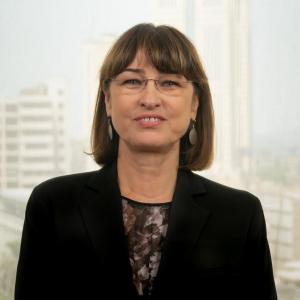
Speech by
Goals we are supporting through this initiative