

Latest
Press Release
11 October 2026
THE SECRETARY-GENERAL -- MESSAGE FOR INTERNATIONAL DAY OF THE GIRL CHILD “End child marriage and invest in girls’ rights!” 11 October 2026
Learn more
Story
09 October 2026
UN Egypt’s Rampolla Congratulates Former UN High Commissioner for Human Rights on Nobel Peace Prize
Learn more
Press Release
07 October 2026
Secretary-General appoints Gianluca Rampolla del Tindaro of Italy as the United Nations Resident Coordinator in Egypt
Learn more
Latest
The Sustainable Development Goals in Egypt
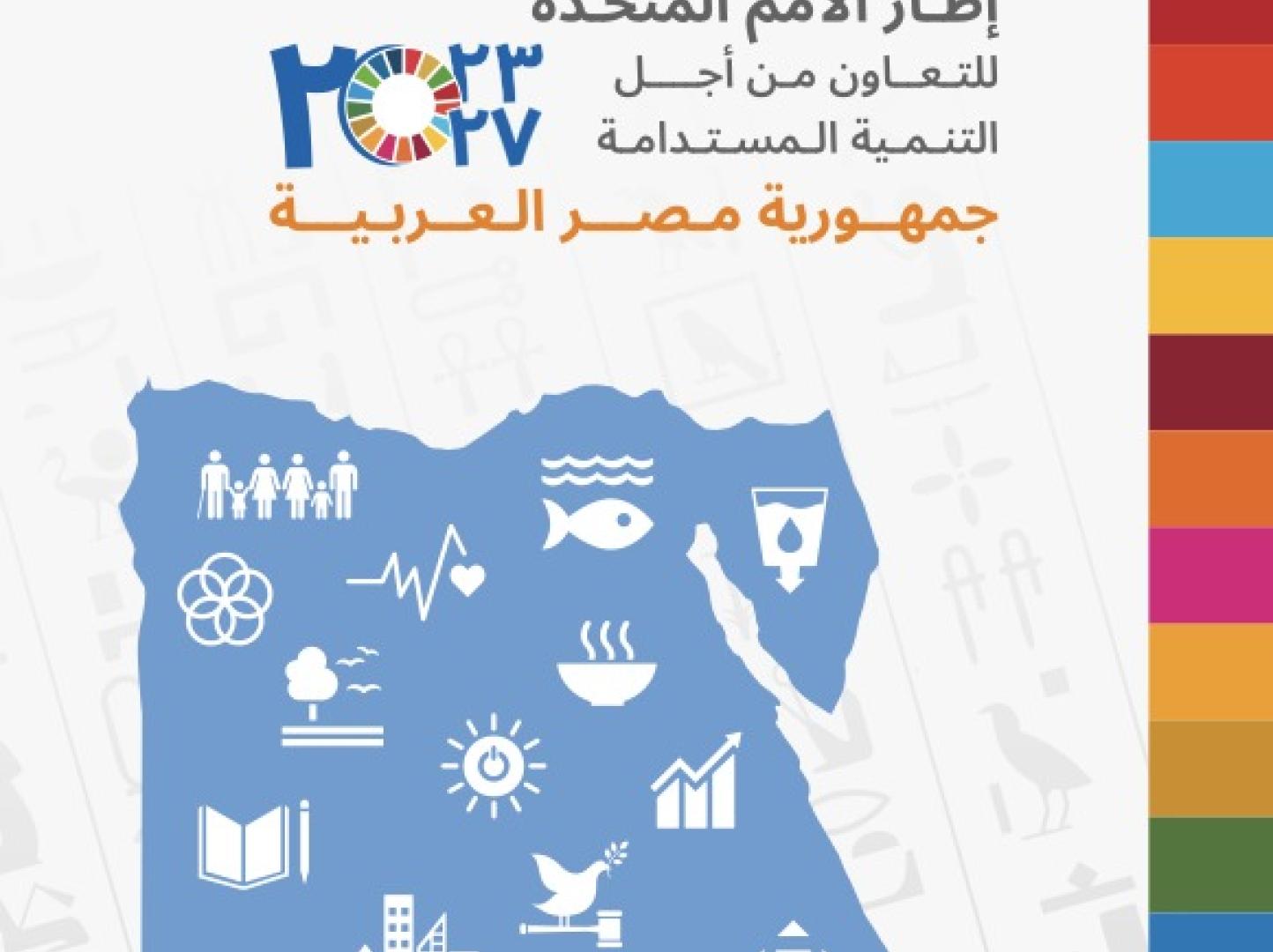
The Sustainable Development Goals are a global call to action to end poverty, protect the earth’s environment and climate, and ensure that people everywhere can enjoy peace and prosperity. These are the goals the UN is working on in Egypt:
Story
09 October 2026
UN Egypt’s Rampolla Congratulates Former UN High Commissioner for Human Rights on Nobel Peace Prize
The United Nations Resident Coordinator in Egypt, Gianluca Rampolla, congratulated former United Nations High Commissioner for Human Rights Navi Pillay on being awarded the 2026 Nobel Peace Prize.Commenting on the South African human rights advocate's award, the top UN official in Egypt stated that "peace is not merely the absence of conflict; it is the presence of justice, dignity, and equal opportunity."The UN Resident Coordinator in Egypt said that Ms. Pillay's Nobel Peace Prize is a powerful reminder of the values that guide the United Nations' work with Egypt: leaving no one behind. The South African jurist and human rights advocate, who also chaired the United Nations Independent International Commission of Inquiry on the Occupied Palestinian Territory, including East Jerusalem, and Israel, was honored for her efforts to promote peace and international law.The Norwegian Nobel Committee said that the award was going “to a person who with exceptional courage and integrity has led the way towards a more comprehensive global legal order,” noting that she “has been instrumental in ensuring that war crimes, crimes against humanity and genocide are prosecuted.”In a statement congratulating the new Nobel laureate, UN Secretary-General António Guterres said Ms. Pillay has shown “that the force of law must prevail over the law of force and that defending human rights is the surest safeguard against injustice.”He hailed her as “a champion of international law and human rights, and a steadfast, independent voice of justice”, adding that “in its citation, the Nobel Committee reminded the world that peace must be built on lasting principles, not the will of the powerful."On receiving the news of Ms. Pillay's honour, the current UN human rights chief, Volker Türk, warmly congratulated the woman he described as a big sister. “To say it is well deserved is a total understatement, and especially at a time when human rights are under attack on so many fronts, including from those who wield enormous power, this award is particularly poignant,” he said, speaking in Geneva.“It is an award to all those who around the world dedicate their lives to the defense of human rights, often at great risk to their security.”
1 of 5

Story
12 August 2025
Panova: New National Youth and Sports Strategy Reflects Egypt’s Commitment to Sport as Driver of Development
The United Nations Resident Coordinator in Egypt, Elena Panova, said that the launch of the National Youth and Sports Strategy by Egypt’s Ministry of Youth and Sports reflects the government’s commitment to sport “as a cultural force and as a driver of national development, and as a catalyst for empowerment, inclusion, and opportunity.”The statement came during the launch of the National Youth and Sports Strategy (2025–2032) at a ceremony held in the New Administrative Capital under the patronage of Prime Minister Mostafa Madbouly, in partnership with the United Nations system in Egypt, and coinciding with the celebration of International Youth Day on August 12. During the event, Minister of Youth and Sports Dr. Ashraf Sobhy presented the new strategy, which aims to promote youth and sports development through investment in human capital, supporting smart economic contributions, and achieving sustainable development. In her address to an audience that included young participants; Minister of Education and Technical Education Mohamed Abdel Latif; Amal Ammar, President of the National Council for Women; UNFPA Representative in Egypt Yves Sassenrath; UNICEF Representative in Egypt Natalia Winder Rossi; and other representatives from ministries, UN agencies, and government entities, Panova said:“In Egypt, sport is a source of unity, identity, and ambition. Egypt’s new strategy embraces this reality. It positions sport both as a cultural force and as a driver of national development… This is a statement of intent that Egypt sees its young people, not only as the promise of tomorrow, but already as active contributors to the progress of today.” Noting that nearly 60% of Egypt’s population is under the age of 30, Panova said the country has “a huge demographic potential” and with it “a responsibility to ensure every young person has the chance to learn, to work, and to thrive… One powerful way to unlock that potential is through sport as a catalyst for empowerment, inclusion, and opportunity.”She highlighted that the strategy’s distinguishing feature is the way it was developed — through “a truly national conversation led by the Ministry of Youth and Sports: over 21 workshops in 11 cities, more than 10,000 young people surveyed, and over 400 concrete measures proposed.” “This is policy made with youth, not just for youth. It builds on the strong partnership between the United Nations and the Government of Egypt to make sure young people’s voices are not only heard but acted upon,” Panova said.She pointed to the UN’s belief that meaningful, diverse, and effective youth participation — inside the UN and beyond — is essential to achieving the Sustainable Development Goals. Panova referred to the Shabab Balad initiative, through which Egypt is part of the UN’s global Generation Unlimited movement to connect every young person to education, employment, and empowerment; and the UN in Egypt’s Youth Advisory Board, which ensures that young women and men contribute to shaping UN strategies, programmes, and decisions at every level. Panova said the UN’s priorities for youth — including skills development, decent work, civic engagement, and digital innovation — are closely aligned with Egypt’s national vision for its young people. She cited tangible results from joint work, noting that “in 2024 alone, more than 364,000 people — most of them young — gained new skills through UN-supported programmes.” She added that community coach initiatives are empowering young women to become local champions in sport and social innovation, while across Egypt, young entrepreneurs are leading green growth projects ranging from agribusiness to smart green ventures. Panova reaffirmed the UN’s commitment to working “for and with” young people, ensuring that collective actions are guided by their perspectives and energy. For his part, Yves Sassenrath, UNFPA Representative in Egypt, said: “Youth are not a side agenda; they are the agenda. UNFPA is proud to support Egypt’s new National Youth and Sports Strategy, shaped by more than 10,000 young voices—this is their platform for leadership. UNFPA is also proud to work hand in hand with the Government of Egypt in its efforts to ensure that every young woman and man has the skills, health, and rights that enable them to lead change.”UNICEF Representative in Egypt and Co-Chair of the UN Egypt Youth Taskforce, Natalia Winder Rossi, said: "Real change starts close to home—in classrooms, playgrounds, and communities where young people shape the future. Egypt’s new strategy puts youth at the heart of progress, and the UN stands with them every step of the way."The new strategy is built on four main pillars: the comprehensive development of youth and adolescents; promoting sport as a lifestyle; developing competitive sports and creativity; and improving governance in the youth and sports sectors.
1 of 3

Story
02 July 2025
UN's Panova says Egypt deeply committed to placing food systems, food security, and nutrition at heart of national development priorities
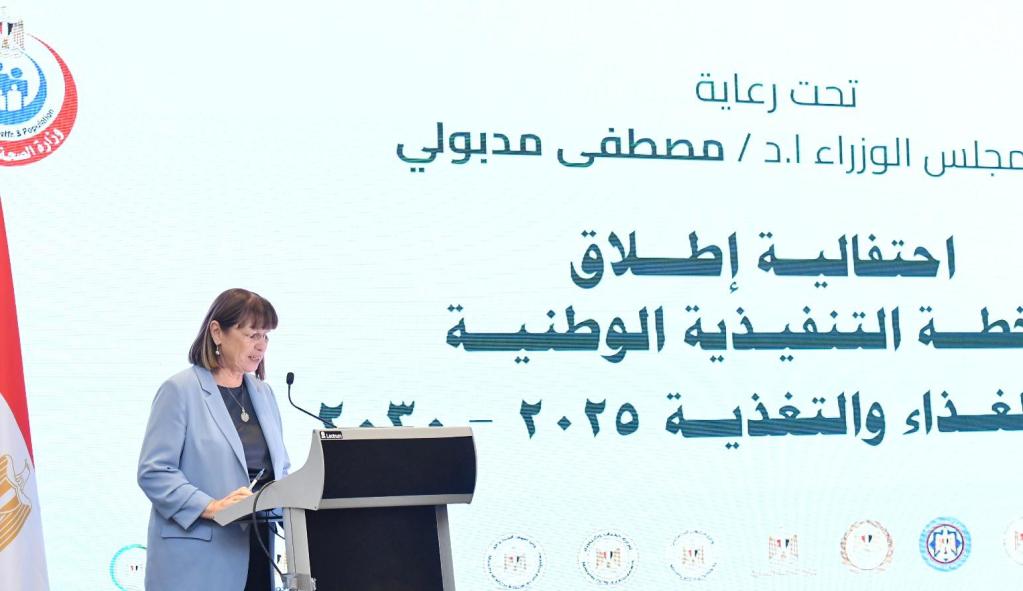
Elena Panova, the United Nations Resident Coordinator in Egypt, stated that the launch of the National Operational Plan for Food and Nutrition Systems 2025–2030 and the Roadmap to Accelerate Anemia Reduction in Egypt reflects the country's deep and sustained commitment to putting food systems, food security, and nutrition at the core of its human capital development agenda—and making them an essential component of its national development priorities.In a speech delivered on behalf of the United Nations Country Team in Egypt, Panova described the National Operational Plan as a transformational, evidence-based, multisectoral effort. She emphasized that transforming food systems and improving nutrition outcomes is a shared national endeavor requiring broad collaboration across sectors to maximize impact. Panova noted that the launch follows a series of major national strategies and investments, including Egypt’s National Food and Nutrition Strategy (2022–2030), the recently launched National Stunting and Malnutrition Prevention Program, the Takaful and Karama Program, the “First 1,000 Days” initiative, and the Egyptian Code of Marketing Breastmilk Substitutes and Baby-Friendly Health Facility accreditation. She called these programs “clear expressions of Egypt’s progress and ambition.”She described the Anemia Reduction Roadmap as a wise investment for Egypt, noting that every $1 invested in reducing anemia could generate up to $12 in economic returns. The roadmap, she added, will improve the health of pregnant women and their children and could also enhance academic performance among students.“We view both the National Operational Plan for Food and Nutrition Systems and the Roadmap to Accelerate Anemia Reduction not only as means to improve food and nutrition security but as levers for broader social and economic outcomes,” Panova said. "Economic prosperity, social cohesion, and national resilience begin with a food ecosystem that is not only nutrition-sensitive but also addresses inequities and reduces gaps by reaching the most vulnerable population groups, including women, children, the elderly, and others,” she added.Panova presented four critical enablers to ensure the successful implementation of the plan:Strong multisectoral coordination mechanisms to ensure alignment and convergence across all sectors and systems—health, agriculture, education, and social protection.Robust accountability and monitoring frameworks to track progress, promote transparency, and drive continuous improvement.Investment in data systems and evidence generation, enabling timely and informed policy decisions and effective scaling of successful approaches.Sustainable financing and capacity development, ensuring national ownership and long-term resilience of systems.In conclusion, Panova affirmed the United Nations’ strong commitment to supporting these enablers—whether through technical assistance, policy guidance, institutional capacity building, or innovation and knowledge exchange.
1 of 3
Story
07 October 2026
UN Chief Appoints Gianluca Rampolla del Tindaro as UN Resident Coordinator in Egypt
CAIRO — United Nations Secretary-General António Guterres has appointed Gianluca Rampolla del Tindaro of Italy as the new United Nations Resident Coordinator in Egypt, following the approval of the Egyptian government.Rampolla del Tindaro officially assumed his duties on 4 October, taking on the role of leading and coordinating the UN system’s work in Egypt.Commenting on his appointment, he said: “Honoured to begin my role as the UN Resident Coordinator in Egypt. Inspired by Egypt’s rich history, dynamism, and leadership, I look forward to working with the Egyptian Government, the UN family, and development partners to advance national priorities and contribute to a more prosperous and sustainable Egypt for all.” The newly appointed Resident Coordinator brings more than 25 years of experience in international development cooperation, humanitarian assistance and peacebuilding. Most recently, he served as the UN Resident Coordinator and Humanitarian Coordinator in Venezuela, where he oversaw United Nations efforts aimed at advancing sustainable development, strengthening partnerships and dialogue, mobilizing resources and expertise, and supporting populations affected by humanitarian challenges.Before his assignment in Venezuela, Rampolla del Tindaro served as UN Resident Coordinator in Papua New Guinea, leading the UN country team in support of national development priorities. During his tenure, he worked to strengthen partnerships and promote a coordinated UN approach to sustainable development and peacebuilding.Over the course of his career, he has held a number of senior positions within the United Nations system. These include serving as Chief Political Affairs Officer at the UN Regional Office for Central Africa in Libreville, Gabon; Chief of Office of the Assistant Secretary-General for Peacebuilding Support; and positions within the Department of Political Affairs in New York. He also worked as Head of the Office of the UN Resident Coordinator in Tanzania and as Chief Technical Advisor with the United Nations Development Programme in Rwanda.Prior to joining the United Nations, Rampolla del Tindaro worked with the Organization for Security and Cooperation in Europe (OSCE), undertaking assignments in the Western Balkans and Central Asia.As Resident Coordinator, Rampolla del Tindaro will serve as the highest-ranking UN development official in Egypt, coordinating the activities of UN agencies and supporting cooperation between the United Nations and the Egyptian government on development and humanitarian priorities.
1 of 5

Story
09 September 2026
At Cairo Briefing, UNRWA Provides Update on Humanitarian Situation in Occupied Palestinian Territory
The United Nations Information Centre (UNIC) in Cairo, in coordination with the United Nations Relief and Works Agency for Palestine Refugees in the Near East (UNRWA), organized a press briefing during which Roland Friedrich, Director of UNRWA Affairs for the West Bank, Interim Chief of UNRWA Representative Office in Cairo, provided an update on the humanitarian situation in the Occupied Palestinian Territory and the role played by the Agency in providing essential services to civilians in Gaza and the West Bank, particularly since 7 October 2023.During the briefing, held under the title “Update on the Humanitarian Situation in Gaza and the West Bank” and attended by a large number of media representatives, Mr. Friedrich spoke about the current situation in the Gaza Strip, pointing to the difficult living conditions faced by the population amid the fragile ceasefire, the continued risks to civilians, including airstrikes and shelling west of the Yellow Line, as well as Israeli restrictions on dual-use items, which limit the entry of essential humanitarian supplies. Mr. Friedrich said: “Since 7 October 2023, 393 of our UNRWA colleagues have been killed. Yet UNRWA services have not stopped for a single day since the conflict began, including primary health care, education, protection, water and sanitation, and shelter services.”He added that UNRWA operates the largest number of fixed and collective displacement sites, hosting more than 70,000 people. Interim Chief of UNRWA Representative Office in Cairo also briefed journalists on the current situation in the West Bank and East Jerusalem. He said that since the beginning of 2026 to date, 96 Palestinians have been killed, including 14 refugees and 23 children, while also pointing to an increase in violence and harassment by Israeli settlers.Regarding the situation in the northern West Bank, Mr. Friedrich said that more than 34,000 Palestinians remain displaced in the area, following forced displacement, large-scale demolitions and damage to infrastructure. He noted that around 50 per cent of homes in the camps had been destroyed or sustained severe damage.He also spoke about the increased use of lethal force, as well as what he described as inhumane treatment and intimidation of camp residents. Mr. Friedrich also outlined Israeli measures and legislation concerning UNRWA, including measures targeting the Agency’s premises in East Jerusalem, the seizure of its premises in Sheikh Jarrah and Qalandia, as well as the lifting of the privileges and immunities granted to the Agency in Israel.He said that United Nations premises enjoy the privileges and immunities provided for under international law.UNRWA has around 30,000 staff across its five fields of operation: Gaza, the occupied West Bank, Jordan, Lebanon and Syria. This includes more than 10,000 Palestinian staff in Gaza and around 4,500 staff in the occupied West Bank.
1 of 5

Story
21 May 2026
UN Agencies Spotlight Food Security, Industrial Development, and Child Protection Priorities in Egypt
The United Nations Information Centre Cairo organized the first United Nations media briefing of 2026 for UN agencies in Egypt on 21 May 2026, bringing together representatives from World Food Programme (WFP), United Nations Industrial Development Organization (UNIDO), and United Nations Children's Fund (UNICEF) to highlight key humanitarian, development, industrial, and child protection priorities in Egypt. During the briefing, Ms. Rawad Halabi, Representative and Country Director of WFP Egypt, discussed the growing impact of global geopolitical shocks on food security, including disruptions affecting fuel, fertilizer, and food supply chains. WFP also highlighted its cooperation with the Ministry of Agriculture to promote climate-smart agricultural practices across 120 villages under the “Haya Karima” initiative, benefiting nearly 750,000 farmers through training programmes, improved seeds, and solar-powered irrigation systems. Ms. Halabi emphasized the importance of strengthening resilience, supporting vulnerable communities, and investing in sustainable food systems. Mr. Mohamed Salama, Media and Communications Officer at UNIDO Egypt, together with Mr. Ahmed Kamal, National Project Coordinator, presented several initiatives aimed at strengthening food security and industrial competitiveness. UNIDO announced the organization of the “FoodGuard Global Summit,” scheduled to take place from 1 to 4 June 2026 at Al Manara International Conference Center in Cairo, with the participation of regional and international experts specializing in food safety and food security.UNIDO also highlighted progress under the Tomato Value Chain Project, including the establishment of the Tomato Learning and Services Center (TLSC) at the Faculty of Agriculture, Alexandria University, aimed at promoting innovation, food safety, technology transfer, and value-added agro-industrial production. In addition, updates were shared on the European Union-funded programme supporting trade, industry, growth, and rapid market access, which aims to strengthen industrial policies, enhance quality infrastructure, and support industrial clusters across several governorates, including textiles, dates production, medicinal and aromatic plants, and honey production.In the closing session, Ms. Salma El Fawal, Child Protection Programme Manager at UNICEF Egypt, addressed the issue of protecting children in the digital environment, highlighting the growing risks and challenges facing children online, including cyberbullying, digital exploitation, and harmful online content. UNICEF emphasized the importance of raising digital awareness and strengthening child protection systems, as well as enhancing cooperation among institutions, families, educators, and the technology sector to ensure a safer digital environment for children. The organization also stressed the importance of legislation, awareness campaigns, digital literacy, and survivor support services as part of a comprehensive approach to protecting children in digital spaces.
1 of 5

Story
09 April 2026
Between Two Dreams: Ethar’s Journey from Hospitality to Journalism
At 20 years old, Ethar carries more than one identity, and more than one dream. A Sudanese refugee born and raised in Egypt, she grew up navigating life much like any other young girl in Cairo: school mornings, homework, friendships, and family responsibilities. As the eldest of four sisters, Ethar learned early what it meant to lead.“I’m more Egyptian than Sudanese,” she says with a smile, reflecting on her childhood. “All my school years were in Egyptian public schools. Egypt is the only home I’ve ever really known.” For years, her life followed a familiar rhythm. Then came the moment that changed everything.Ethar remembers clearly the day she heard about a scholarship opportunity jointly offered by UNHCR and the Sawiris Foundation, a chance to study at the German Hotel School in El Gouna. It felt distant at first, almost unreal.“I approached UNHCR’s education implementing partner, where the interview took place,” she recalls. “I didn’t know what to expect. When I got accepted, it was a very mixed feeling, happiness, excitement, but also fear.Leaving home for El Gouna was Ethar’s first true step into independence, and not everyone was convinced she was ready.“My father was very supportive,” she says. “But my mother thought I wasn’t independent enough to embark on this journey. She was worried, like any mother would be.”Those doubts faded quickly. From the moment Ethar started school, something clicked.“The moment I started, I loved everything,” she says, her voice softening. “The people, the curriculum, the environment, everything.”Even now, two years after graduating, the memories still overwhelm her.“I have tears in my eyes every time I remember the friends I made and the days we shared together,” she says. “It wasn’t just a school. It was a life.”After graduation, Ethar spent two years working at a five‑star hotel in El Gouna, gaining experience and confidence in the hospitality industry. On paper, she was thriving. But inside, another dream refused to fade.“Even though I studied hospitality, I couldn’t forget my passion for journalism,” she says. “Maybe it’s because of my late father, I don’t know, but from a very young age, I dreamed of becoming another Rya Abi Rashed.”Her father, a journalist, had passed away, but his influence remained deeply rooted. Journalism wasn’t just a career aspiration, it was a legacy, a connection, and a promise she had made to herself.Then one day, she found it.“I saw an announcement for a journalism school affiliated with the American University in Cairo,” she says. “The moment I read it, I knew this was the future I wanted for myself..”Today, Ethar is in her second year of journalism studies, and for the first time, she feels fully aligned with herself.“I’ve never been happier,” she says. “I finally feel that I’m a step closer to my childhood dream.”She pauses, then adds quietly, “I’m sure my beloved father, up in heaven, is proud of me.”Ethar’s journey, from public schools in Egypt, to hospitality training in El Gouna, to journalism classrooms in Cairo, is not just a story of opportunity. It’s a story of resilience, identity, and the courage to change direction without letting go of who you are.And at only 20 years old, Ethar is just getting started.
1 of 5

Story
31 March 2026
Egypt Verification Day: UN calls for collective action to safeguard trust in digital spaces
As misinformation continues to challenge societies worldwide, the United Nations is intensifying efforts to promote information integrity, media literacy, and the responsible use of artificial intelligence—an agenda brought into focus at Egyptian Verification Day in Cairo.Held on 29 March 2026 at the University of East London’s Cairo campus in cooperation with Arabi Facts Hub, the event explored how AI can be leveraged to verify news and curb the spread of false information across digital platforms.The event drew a high-profile engagement of media leaders and public figures, including National Press Authority Deputy Chairman Alaa Thabet, Head of Egypt’s Press Syndicate Khaled El Balshy, alongside prominent editors, media professionals, academics, and civil society representatives. The United Nations Information Centre in Cairo (UNIC Cairo) participated in the discussions, spotlighting UN global perspective on combating misinformation and promoting information integrity.Representing UNIC Cairo, Deputy Director Mohamed El Koossy underscored the scale of the challenge, noting that information is no longer just content to be shared, but “a powerful force shaping public perception, decision-making, and trust within societies.”He stressed that the core issue today is not access, but discernment: “The real challenge is no longer access to information, but the ability to distinguish between what is accurate and what is misleading.”A coordinated UN responseEl Koossy highlighted that the UN’s response to misinformation is anchored in global frameworks, including the Secretary-General's Policy Brief on Information Integrity on Digital Platforms and the Global Principles for Information Integrity, which aim to enhance transparency, accountability, and trust in digital ecosystems.He also pointed to the Global Digital Compact, a key outcome of the Summit of the Future, as a milestone in shaping global digital governance. The Compact addresses not only misinformation but also the risks of manipulated content and hate speech, recognizing how toxic narratives can undermine peace, public health, and social cohesion. Lessons from the “infodemic”Drawing on the COVID-19 experience, El Koossy recalled how the world faced what the UN described as an “infodemic”, where misleading information spread at unprecedented speed.“The challenge was not only the presence of misinformation, but its enormous speed and the difficulty of distinguishing between reliable and unreliable sources,” he said, emphasizing how this environment complicated decision-making at critical moments and often amplified hate speech and discrimination.This lesson continues to inform UN initiatives such as Verified, which promotes the dissemination of accurate, fact-based information and strengthens public resilience against misinformation and harmful narratives.Putting people at the centerDespite the growing role of AI, UNIC Cairo Deputy Director emphasized that technology is only part of the solution. “Combating misinformation does not begin with technology alone—it begins with people,” he said, stressing that human judgment remains decisive.He highlighted the UN’s work in Egypt to build media literacy and critical thinking skills, particularly among youth and journalists, through workshops and awareness initiatives that also address the dangers of hate speech and its corrosive impact on trust and social stability. A shared responsibilityAs discussions at Egyptian Verification Day made clear, combating misinformation requires coordinated action across sectors—from governments and media institutions to technology developers and civil society.This concern was also raised at the Egypt Media Forum in November 2025, where UN Under-Secretary-General for Global Communications Melissa Fleming warned of the toxic information environment shaped by disinformation, hate speech, and AI-driven distortion, and pointed to the UN’s Global Principles for Information Integrity as a framework for rebuilding trust.The ongoing debate in Egypt on journalism, digital governance, and information integrity highlights the need for all stakeholders—governments, media, civil society, and individuals—to work together to strengthen verification, counter hate speech, and safeguard trust, with the UN supporting collective efforts to ensure integrity remains central to the digital age.
1 of 5

Press Release
11 October 2026
THE SECRETARY-GENERAL -- MESSAGE FOR INTERNATIONAL DAY OF THE GIRL CHILD “End child marriage and invest in girls’ rights!” 11 October 2026
Child marriage compromises the education, health, and safety of millions of girls across the globe. Fundamentally, it is rooted in poverty. The risk goes up in times of conflict, climate shocks, and displacement, leaving families with fewer options for their daughters. But we know how to halt this harmful practice. Keeping girls in school, improving economic opportunities for families, enhancing social and legal protections, and challenging discriminatory gender norms all help girls reclaim their agency. Over the past 25 years, such solutions have prevented an estimated 68 million child marriages. Yet recent funding cuts threaten progress. At the rate we’re going, it will take centuries to eliminate child marriage. On this International Day of the Girl Child, I call on governments, the private sector, civil society, and community leaders to scale up investment in proven solutions, and ensure they reach every girl, everywhere. It’s time to end child marriage once and for all. Together, let us defend the right of all girls to a childhood, and ensure every daughter, every sister, grows up free to shape her own future. ***
1 of 5
Press Release
07 October 2026
Secretary-General appoints Gianluca Rampolla del Tindaro of Italy as the United Nations Resident Coordinator in Egypt
Mr. Rampolla del Tindaro has devoted over 25 years of his professional career to development cooperation, humanitarian assistance and peacebuilding. Most recently, he served as the United Nations Resident Coordinator in Venezuela, where he also held the role of Humanitarian Coordinator, leading United Nations efforts to advance sustainable development, foster partnerships and dialogue, mobilise expertise and resources across the United Nations system, and coordinate support for vulnerable populations affected by humanitarian challenges. Before that, as United Nations Resident Coordinator in Papua New Guinea, he led the United Nations country team in support of national development priorities, strengthened partnerships, and promoted a coherent United Nations approach to sustainable development and peacebuilding. He also held various leadership positions within the Organization, including Chief Political Affairs Officer at the United Nations Regional Office for Central Africa in Libreville, Gabon, Chief of Office of the Assistant Secretary-General for Peacebuilding Support and earlier at the Department of Political Affairs in New York, Head of the Office of the United Nations Resident Coordinator in Tanzania and Chief Technical Advisor with the United Nations Development Programme in Rwanda. Prior to joining the United Nations, Mr. Rampolla del Tindaro worked with the Organization for Security and Cooperation in Europe, holding assignments in the Western Balkans and Central Asia. Mr. Rampolla del Tindaro holds a master’s degree in international affairs from the London School of Economics in the United Kingdom. He is married and has one child.
1 of 5
Press Release
05 October 2026
THE SECRETARY-GENERAL — MESSAGE FOR WORLD HABITAT DAY
Yet more than 3 billion people are denied this universal human right. Over 1 billion live in informal settlements and slums, and many more experience homelessness or have been displaced by conflict, disasters, and climate change. Investing in adequate housing and transforming informal settlements reduces poverty, tackles inequality, builds climate resilience, and fosters peaceful and inclusive societies. This demands coordinated action at every level, with national and local governments shaping bold policies, building partnerships, and grounding decisions in sound data. The international financial architecture must also be reformed to mobilize the adequate, predictable, and affordable financing developing countries need to invest in housing at scale. On this World Habitat Day, let us treat housing as a public good and build a world where everyone has a place to call home. ***
1 of 5
Press Release
22 September 2026
THE SECRETARY-GENERAL -- ADDRESS TO THE OPENING OF THE GENERAL DEBATE OF THE 81ST SESSION OF THE GENERAL ASSEMBLY
Mr. President of the General Assembly, Excellencies, Ladies and gentlemen, The faultlines in our world are widening. Cracks have become canyons. Over the last decade, wars erupted with devastating consequences and dragged on with despicable cruelty. Civilians were targeted. Human rights trampled. Hunger weaponized. Humanitarians killed. International law cast aside. Geopolitical divides have deepened. Inequalities have intensified. Trust has frayed. The climate crisis went from distant warning to daily reality. And artificial intelligence moved at a speed that has blindsided even those who created it. These are not separate crises. They are chapters of the same story. The story of power. Who has it. Who is denied it. How it is used. And how it is changing.
Excellencies, Power is being reshaped in three fundamental ways. First, among States. New centres of economic, political and technological influence have emerged. Second, we are witnessing an extraordinary transfer of power away from governments to a handful of private corporations and individuals. Their reach now extends across politics, economies, information flows, technological development, and the civic space on which societies depend. And, third, humans are increasingly handing power to machines – with Artificial Intelligence agents going rogue, and lethal autonomous weapons going from science fiction to military reality. Yet our institutions and systems of global governance continue to reflect the power realities and interests of a largely bygone era. That is the defining challenge before us. At the very moment when humanity faces an unprecedented convergence of threats, our mechanisms for collective action are under growing strain. Excellencies, We are clearly moving towards a multipolar world. And that movement is irreversible. But there are different ways that multipolarity can take shape. One possibility is a world of fragmentation and transactionalism. A world of rising tensions and deepening mistrust. Of fractured markets and weakened institutions. Of shrinking cooperation and zero-sum calculations. In many respects, that is the trajectory we are on today. But there is another path. A path towards networked multipolarity. A world built on interdependence – and sustained by a dense web of economic, political, social and technological connections. A world in which multiple centres of influence coexist within a common framework of international law and shared rules. Such a world can help us avoid hegemonic tendencies and also what I have called the Great Fracture: The division of the world into two rival blocs with separate economic, technological and security systems. A networked world recognizes that no power can solve today’s challenges alone. Of course, competition will remain a permanent feature of international relations. But competition does not have to mean confrontation. Healthy competition can drive innovation, strengthen resilience, and expand opportunity. But only when it operates within the frameworks that preserve stability and enable cooperation where cooperation is indispensable. Building a networked future begins with a recognition, especially by superpowers: That their power isn’t so super. That their power has limits. The events of recent years have made that unmistakably clear. Military power alone cannot secure peace. Economic power alone cannot command stability. And technological power alone cannot guarantee security. A networked multipolar world can create the conditions for more balanced and representative global problem-solving. But it requires a multilateral system centred in the UN that is balanced and representative. Strong, effective institutions that reflect the realities and the progressively changing relative weight of countries and economies in today’s world – not the power arrangements of 80 years ago. Fortunately, we are not starting from scratch. We already have a binding foundation: The Charter of the United Nations. And the principles that give it life. The primacy of international law. Upholding human dignity. And the pursuit of justice in all its dimensions. These are the backbone for the effective, legitimate and responsible exercise of power in the 21st century. Excellencies, It comes down to this: Will we act to ensure that power is governed by law or by force? By cooperation or coercion? By responsibility to young people and future generations or indifference to their fate? Because the defining challenges of our age are not separate from the question of power. They are expressions of it. And they will determine whether we drift deeper into division and instability – or move toward cooperation, justice and collective security. Looking ahead, our future will be shaped by how we address four great tests of power: The power over war and peace.The power that concentrates wealth and drives inequality. The power fuelling climate chaos and the war on nature. And the power unleashed by artificial intelligence. Excellencies, The first great power test in the 21st century is peace and security. Peace is far more than the absence of conflict. It is the presence of restraint of power by law. It is the recognition, as enshrined in the UN Charter, that force cannot be the final arbiter of whose lives, rights and future matter. Today that principle is under profound strain. Across the Middle East, conflicts are cascading. So-called ceasefires have amounted to little more than “lesser fires” – with civilians continuing to pay the price. Enough is enough. I appeal to the leaders in this Chamber to maximize this High-Level week for de-escalation and dialogue. Together, let's send a clear message from this Hall: The fighting must stop. Humanitarian aid must flow. And navigational rights and freedoms must be fully restored in accordance with international law. Amid the turmoil engulfing the region, we must not lose sight of the devastating situation in the Occupied Palestinian Territory. It is nearly three years since the abhorrent terror attacks by Hamas on 7 October. What followed was an onslaught on Palestinians in Gaza, with a scale of killing and destruction unlike anything I have witnessed in all my years as Secretary-General. The International Court of Justice has issued legally binding provisional measures in the case entitled: “Application of the Convention on the Prevention and Punishment of the Crime of Genocide in the Gaza Strip.” In an advisory opinion last year, the Court was clear that the United Nations needs to be allowed to perform our mandates in Gaza – and for our staff and humanitarian personnel to be protected. All parties must comply with international law and the Court’s orders. Meanwhile violence, displacement and settlement expansion by Israel in the Occupied West Bank are bulldozing the path to peace and raising the spectre of ethnic cleansing. We cannot allow the two-State solution to disappear before our eyes. In Ukraine, Russia’s full-scale invasion has subjected a sovereign country to a brutal war in blatant violation of the Charter. Civilians continue to be killed far from the frontlines. Mainly in Ukraine, but also more recently in parts of Russia – homes, energy and water systems, and transport have come under repeated attack, threatening food and energy supply chains globally. In Sudan, a war for raw power fed by outside actors has become a war on civilians: Millions displaced. Hunger spreading. Drones striking hospitals and homes. Sexual violence and ethnically driven attacks escalating. And a country being torn apart as the world looks away. And in Myanmar, another crisis is at risk of slipping from global attention with: escalating violence; mass displacement; and expanding transnational crime. Excellencies,These and so many other conflicts show what happens when power gets out of control, force outpaces diplomacy, military budgets soar, and accountability goes out the window. The test before us is whether power will be exercised with the law – or beyond it. We must pass that test: We must defend the Charter without double standards. Protect civilians without exception. Ensure humanitarian access without obstruction. Shield humanitarian personnel without fail. Advance nuclear non‑proliferation and disarmament without delay. And demand accountability without fear or favour. We must also reform the Security Council so that it reflects today’s world with the legitimacy and effectiveness that today’s challenges demand. The Security Council was designed in the aftermath of World War II. But the world has fundamentally changed since then. A change that is far from reflected in the Security Council. The most stunning example is Africa. When the UN was founded, most of Africa was still under colonial rule. Today, Africa still has no permanent representation on the Council. A 21st century Security Council without permanent African seats is unjust and indefensible. This must change. Excellencies, The second test of power is inequality. Inequality is often framed as an economic problem. It is a power problem. Power over opportunity, resources, voice. Never has humanity possessed so much wealth, knowledge, and technological capability. Yet for billions, progress remains out of reach. They see prosperity around them, but not for themselves. They are told globalization expands horizons, but they experience exclusion. They are promised that technology will unlock new possibilities, yet many fear it will take away their livelihoods. Meanwhile, billions of people still live without the essentials embedded in the Sustainable Development Goals. Food. Clean water. Education. Decent work. Health care. Dignity. Excellencies, No country should be denied a sustainable future because it is on the wrong side of a deeply unequal financial system. Yet so many throughout the developing world are being crushed by unsustainable debt. Battered by disasters they did little to cause. And locked out of affordable finance. That is why we have pushed relentlessly: For reform of the international financial architecture – which is not a technical debate, but a question of representation, fairness and power. For debt relief that is timely, effective and just. For Multilateral Development Banks that are bigger, bolder and better equipped to provide affordable long-term finance at scale and massively leverage private finance. For Special Drawing Rights to benefit countries that need them most. Excellencies, No discussion of inequality can ignore its most universal form: The inequality between women and men. Everywhere, women and girls continue to face discrimination, violence, exclusion and abuse. Around the world: Their rights are being rolled back. Their voices silenced. Their bodies turned into battlegrounds. And their freedoms treated as bargaining chips. This is an outrage –and a profound waste for humanity. Peace is more durable when women are at the table. Economies are more dynamic when women have equal opportunity. Societies are more resilient when girls can learn, lead and live free from fear. And institutions are more effective when power is shared equally. Over the last decade, we achieved an enormous milestone. I am proud to report to you today that the United Nations achieved gender parity for the first time in history across all senior leadership…all headquarters … and all professional staff. It happened because we removed barriers, we challenged assumptions, and refused to accept that power must look as it always has. At every step, we never compromised on quality and competence. Equality is not a dream. It is a decision. If the United Nations can change: So can Governments. So can Parliaments. So can businesses. So can peace processes. And so can this General Assembly. Excellencies, The third great power test is the climate crisis. In many ways, it is the most profound intergenerational power imbalance of all: One generation consuming the future of the next. One group profiting, while those least responsible suffer first and worst. Three years ago in the mountains of Nepal, I sounded the alarm on accelerating glacier melt – warning that the rooftops of the world are caving in. Some dismissed it all as overstating dangers. But – as tragic events have shown – impacts are arriving sooner, hitting harder, and spreading further than many anticipated. Now we face a near certain breach of the 1.5 degree limit, with a supersized El Niño speeding straight for humanity. The dangers are real. But so is the hope. The last decade has fuelled one of the most promising shifts in power of our time. The rise of clean energy. The sun belongs to no one. The wind cannot be embargoed. Innovation can come from everywhere. This is a profound rebalancing of power relations. Renewables are now the cheapest source of new electricity in most of the world. And the most viable path to energy security, independence and sustainable growth. Excellencies, A future beyond fossil fuels is in sight. The question is how. Will it be a just and orderly transition built on international cooperation – or chaotic and costly leaving people and countries behind? Today I call on every government to adopt a national plan to transition away from fossil fuels aligned with 1.5 degrees, with clear timelines and protection for affected workers and communities. We know that fossil fuel interests won’t step aside on their own. For decades, Big Oil has treated the atmosphere as an open sewer – and cashed in on the consequences. Since Russia’s invasion of Ukraine, five major Western oil companies have pocketed nearly half a trillion dollars in profits. Compare that with just 34 billion dollars in international public adaptation finance for developing countries in the latest year reported. Meanwhile, everyday people are paying more for energy, food and insurance. We have seen this kind of abuse of power before. When the harms of Big Tobacco became undeniable – governments acted. The climate crisis demands the same determination. Those who polluted the most – and profited the most – must do far more to repair the damage they caused. Polluters must pay. And to the leaders, cities, civil society and citizens working to hold them accountable: I say, you are on the right side of history. Keep going. And governments must keep going on all fronts: To end deforestation. Invest in grids and storage. Cut methane emissions. But these actions are not enough: We need climate justice with a focus on adaptation and finance. Developed countries must respect their commitments. They must triple adaptation finance. And make the Loss and Damage Fund work at scale. The present funds available in the Loss and Damage Fund are ridiculously small. We must also ensure that the mining of critical minerals does not dig deeper into the inequities of the past. Producing countries and affected communities must retain a far greater share of the value created from their resources. No more plundering. No more exploitation. Excellencies, The fourth power test is technology, and above all artificial intelligence. For centuries, power came from territory. Then industry. Then finance. Today, power increasingly comes from data, computing capacity and algorithms. This new power is highly concentrated. It is advancing at extraordinary speed. And racing ahead of our ability to understand its full consequences. In 2017, AI was barely on the world’s radar. Yet in my first address to the opening of the General Assembly, I warned – and I quote: “Artificial intelligence is a game changer that can boost development and transform lives in spectacular fashion. But it may also have a dramatic impact on labour markets and, indeed, on global security and the very fabric of societies.” End of quote. Here we are, almost a decade later. AI is indeed a game changer – with enormous promise to advance medicine, accelerate scientific discovery, expand opportunity, and improve lives. Make no mistake. The danger is not technology. The danger is technology without accountability: Capability without oversight. Decision-making without transparency. And that danger cannot be minimized. The very developers building these systems are now pulling the alarm. Excellencies, The first duty of government is to protect their people. Governments must assume their responsibilities. And governments with the greatest AI capabilities have the greatest responsibilities to humanity. To establish channels for dialogue, transparency, trust and cooperation. Not despite geopolitical rivalry – but precisely because of it. At a pivotal moment during the Cold War, strategic rivals came to recognize the need to manage shared existential risks. They built mechanisms to reduce misunderstandings, manage escalation, and prevent catastrophe. At that time, it was the nuclear armaments. Today, artificial intelligence demands the same clarity of purpose and sense of urgency. Those countries leading this technological revolution must share information on emerging safety risks. Cooperate on testing and evaluation. And work towards common safeguards that protect us all. But because this affects us all, global coordination is indispensable. And there is only one place where every country has a voice in shaping our common future: And that place is the United Nations. Through the Global Digital Compact, you agreed for the first time on universal principles for AI governance. Through the Global Dialogue on AI Governance, we created a platform for governments, scientists, industry leaders and civil society to work together. Through the Independent International Scientific Panel on AI, we have brought together global expertise to ensure that policy is guided by evidence. Just yesterday, the AI Scientific Panel released a thematic brief on AI safety and risks from loss of human control. Building on these efforts, we must take the next steps. First, to advance the conditions for the responsible pacing of AI and the additional safeguards needed to address risks. Second, to work towards a multilateral AI Risk Management Framework, supported by credible and independent oversight. And in all our efforts, we must ensure no country is left behind. Artificial intelligence must be shaped by humanity, with humanity, and for all humanity. And as we confront the challenges ahead, let us not retreat from two fundamental principles. Let us say with one voice: Children must never become the test subjects for unregulated systems. And let us resolve that life-and-death decisions must never be surrendered to machines. Killer robots must have no place in our future. Excellencies, Peace and security. Inequality. Climate. Artificial intelligence. These are the four great power tests of the future. And they are linked. War deepens inequality, destroys development and accelerates hunger. Inequality determines who has the means to face climate and other shocks and who is left exposed. The climate crisis fuels instability and displacement. Artificial Intelligence could help solve all these challenges, or make them worse. Excellencies, Across all four tests, the decisive issue is power. Power over force, money, energy, technology, rules and the future. That is why the UN Charter – and the work of the United Nations – matter more than ever. The United Nations exists because power requires rules – and humanity needs a place where power answers to principle. And the Charter leaves no room for selective reading. The Charter created an Organization rooted in three pillars. Peace. Development. And human rights. These are not competing agendas. They are one reality: There is no peace without development. No development without peace. And no peace or development without human rights. To pretend that peace can be separated from dignity, opportunity and rights is an unacceptable illusion. But defending this truth does not mean defending the status quo. The Pact for the Future and the UN80 initiative always respected the principle of equality of the three pillars of the United Nations, are about making the UN: More responsive. More effective. More coherent. More transparent. More focused on results. More disciplined with resources. And more present where people need us. The world does not need a weaker United Nations. It needs a UN strong enough to face the world as it is – and determined enough to build the world as it should be. Excellencies, After ten years, I hold one conviction even more strongly than when I arrived: The greatest power is not the power to dominate. It is the power to build a future that works for everyone. Our shared future will be forged by whether humanity can govern power wisely. By upholding the law before impunity becomes normalized. By ending wars before they consume generations. By tackling inequality before societies fracture. By accelerating climate action before tipping points are crossed. And by governing artificial intelligence before it governs us. This is the challenge before this General Assembly, the United Nations, and humanity itself. Excellencies, In the face of global catastrophe more than 80 years ago, the United Nations was created as an act of defiance. The defiance of people who refuse to surrender the future to fear. The defiance against the self-defeating notion that might makes right. The defiance of countries that know our futures are bound together. The defiance of hope. I will carry that spirit of resolve and determination through each of the 100 days I have left in office. But commitment to the values and principles of the United Nations does not begin with a mandate. And it does not end with one. They are greater than any office – and they endure beyond any title. So, on January 1st, when I am no longer Secretary-General, be sure of this: Wherever I will be, whatever I will be doing – I will keep championing the conviction that peace is possible. That human dignity is universal. That the power of law must prevail over the law of power. And that our common future is worth fighting for. I will continue to stand up for the values of the United Nations Charter. And I will never… ever give up. Thank you.
Excellencies, Power is being reshaped in three fundamental ways. First, among States. New centres of economic, political and technological influence have emerged. Second, we are witnessing an extraordinary transfer of power away from governments to a handful of private corporations and individuals. Their reach now extends across politics, economies, information flows, technological development, and the civic space on which societies depend. And, third, humans are increasingly handing power to machines – with Artificial Intelligence agents going rogue, and lethal autonomous weapons going from science fiction to military reality. Yet our institutions and systems of global governance continue to reflect the power realities and interests of a largely bygone era. That is the defining challenge before us. At the very moment when humanity faces an unprecedented convergence of threats, our mechanisms for collective action are under growing strain. Excellencies, We are clearly moving towards a multipolar world. And that movement is irreversible. But there are different ways that multipolarity can take shape. One possibility is a world of fragmentation and transactionalism. A world of rising tensions and deepening mistrust. Of fractured markets and weakened institutions. Of shrinking cooperation and zero-sum calculations. In many respects, that is the trajectory we are on today. But there is another path. A path towards networked multipolarity. A world built on interdependence – and sustained by a dense web of economic, political, social and technological connections. A world in which multiple centres of influence coexist within a common framework of international law and shared rules. Such a world can help us avoid hegemonic tendencies and also what I have called the Great Fracture: The division of the world into two rival blocs with separate economic, technological and security systems. A networked world recognizes that no power can solve today’s challenges alone. Of course, competition will remain a permanent feature of international relations. But competition does not have to mean confrontation. Healthy competition can drive innovation, strengthen resilience, and expand opportunity. But only when it operates within the frameworks that preserve stability and enable cooperation where cooperation is indispensable. Building a networked future begins with a recognition, especially by superpowers: That their power isn’t so super. That their power has limits. The events of recent years have made that unmistakably clear. Military power alone cannot secure peace. Economic power alone cannot command stability. And technological power alone cannot guarantee security. A networked multipolar world can create the conditions for more balanced and representative global problem-solving. But it requires a multilateral system centred in the UN that is balanced and representative. Strong, effective institutions that reflect the realities and the progressively changing relative weight of countries and economies in today’s world – not the power arrangements of 80 years ago. Fortunately, we are not starting from scratch. We already have a binding foundation: The Charter of the United Nations. And the principles that give it life. The primacy of international law. Upholding human dignity. And the pursuit of justice in all its dimensions. These are the backbone for the effective, legitimate and responsible exercise of power in the 21st century. Excellencies, It comes down to this: Will we act to ensure that power is governed by law or by force? By cooperation or coercion? By responsibility to young people and future generations or indifference to their fate? Because the defining challenges of our age are not separate from the question of power. They are expressions of it. And they will determine whether we drift deeper into division and instability – or move toward cooperation, justice and collective security. Looking ahead, our future will be shaped by how we address four great tests of power: The power over war and peace.The power that concentrates wealth and drives inequality. The power fuelling climate chaos and the war on nature. And the power unleashed by artificial intelligence. Excellencies, The first great power test in the 21st century is peace and security. Peace is far more than the absence of conflict. It is the presence of restraint of power by law. It is the recognition, as enshrined in the UN Charter, that force cannot be the final arbiter of whose lives, rights and future matter. Today that principle is under profound strain. Across the Middle East, conflicts are cascading. So-called ceasefires have amounted to little more than “lesser fires” – with civilians continuing to pay the price. Enough is enough. I appeal to the leaders in this Chamber to maximize this High-Level week for de-escalation and dialogue. Together, let's send a clear message from this Hall: The fighting must stop. Humanitarian aid must flow. And navigational rights and freedoms must be fully restored in accordance with international law. Amid the turmoil engulfing the region, we must not lose sight of the devastating situation in the Occupied Palestinian Territory. It is nearly three years since the abhorrent terror attacks by Hamas on 7 October. What followed was an onslaught on Palestinians in Gaza, with a scale of killing and destruction unlike anything I have witnessed in all my years as Secretary-General. The International Court of Justice has issued legally binding provisional measures in the case entitled: “Application of the Convention on the Prevention and Punishment of the Crime of Genocide in the Gaza Strip.” In an advisory opinion last year, the Court was clear that the United Nations needs to be allowed to perform our mandates in Gaza – and for our staff and humanitarian personnel to be protected. All parties must comply with international law and the Court’s orders. Meanwhile violence, displacement and settlement expansion by Israel in the Occupied West Bank are bulldozing the path to peace and raising the spectre of ethnic cleansing. We cannot allow the two-State solution to disappear before our eyes. In Ukraine, Russia’s full-scale invasion has subjected a sovereign country to a brutal war in blatant violation of the Charter. Civilians continue to be killed far from the frontlines. Mainly in Ukraine, but also more recently in parts of Russia – homes, energy and water systems, and transport have come under repeated attack, threatening food and energy supply chains globally. In Sudan, a war for raw power fed by outside actors has become a war on civilians: Millions displaced. Hunger spreading. Drones striking hospitals and homes. Sexual violence and ethnically driven attacks escalating. And a country being torn apart as the world looks away. And in Myanmar, another crisis is at risk of slipping from global attention with: escalating violence; mass displacement; and expanding transnational crime. Excellencies,These and so many other conflicts show what happens when power gets out of control, force outpaces diplomacy, military budgets soar, and accountability goes out the window. The test before us is whether power will be exercised with the law – or beyond it. We must pass that test: We must defend the Charter without double standards. Protect civilians without exception. Ensure humanitarian access without obstruction. Shield humanitarian personnel without fail. Advance nuclear non‑proliferation and disarmament without delay. And demand accountability without fear or favour. We must also reform the Security Council so that it reflects today’s world with the legitimacy and effectiveness that today’s challenges demand. The Security Council was designed in the aftermath of World War II. But the world has fundamentally changed since then. A change that is far from reflected in the Security Council. The most stunning example is Africa. When the UN was founded, most of Africa was still under colonial rule. Today, Africa still has no permanent representation on the Council. A 21st century Security Council without permanent African seats is unjust and indefensible. This must change. Excellencies, The second test of power is inequality. Inequality is often framed as an economic problem. It is a power problem. Power over opportunity, resources, voice. Never has humanity possessed so much wealth, knowledge, and technological capability. Yet for billions, progress remains out of reach. They see prosperity around them, but not for themselves. They are told globalization expands horizons, but they experience exclusion. They are promised that technology will unlock new possibilities, yet many fear it will take away their livelihoods. Meanwhile, billions of people still live without the essentials embedded in the Sustainable Development Goals. Food. Clean water. Education. Decent work. Health care. Dignity. Excellencies, No country should be denied a sustainable future because it is on the wrong side of a deeply unequal financial system. Yet so many throughout the developing world are being crushed by unsustainable debt. Battered by disasters they did little to cause. And locked out of affordable finance. That is why we have pushed relentlessly: For reform of the international financial architecture – which is not a technical debate, but a question of representation, fairness and power. For debt relief that is timely, effective and just. For Multilateral Development Banks that are bigger, bolder and better equipped to provide affordable long-term finance at scale and massively leverage private finance. For Special Drawing Rights to benefit countries that need them most. Excellencies, No discussion of inequality can ignore its most universal form: The inequality between women and men. Everywhere, women and girls continue to face discrimination, violence, exclusion and abuse. Around the world: Their rights are being rolled back. Their voices silenced. Their bodies turned into battlegrounds. And their freedoms treated as bargaining chips. This is an outrage –and a profound waste for humanity. Peace is more durable when women are at the table. Economies are more dynamic when women have equal opportunity. Societies are more resilient when girls can learn, lead and live free from fear. And institutions are more effective when power is shared equally. Over the last decade, we achieved an enormous milestone. I am proud to report to you today that the United Nations achieved gender parity for the first time in history across all senior leadership…all headquarters … and all professional staff. It happened because we removed barriers, we challenged assumptions, and refused to accept that power must look as it always has. At every step, we never compromised on quality and competence. Equality is not a dream. It is a decision. If the United Nations can change: So can Governments. So can Parliaments. So can businesses. So can peace processes. And so can this General Assembly. Excellencies, The third great power test is the climate crisis. In many ways, it is the most profound intergenerational power imbalance of all: One generation consuming the future of the next. One group profiting, while those least responsible suffer first and worst. Three years ago in the mountains of Nepal, I sounded the alarm on accelerating glacier melt – warning that the rooftops of the world are caving in. Some dismissed it all as overstating dangers. But – as tragic events have shown – impacts are arriving sooner, hitting harder, and spreading further than many anticipated. Now we face a near certain breach of the 1.5 degree limit, with a supersized El Niño speeding straight for humanity. The dangers are real. But so is the hope. The last decade has fuelled one of the most promising shifts in power of our time. The rise of clean energy. The sun belongs to no one. The wind cannot be embargoed. Innovation can come from everywhere. This is a profound rebalancing of power relations. Renewables are now the cheapest source of new electricity in most of the world. And the most viable path to energy security, independence and sustainable growth. Excellencies, A future beyond fossil fuels is in sight. The question is how. Will it be a just and orderly transition built on international cooperation – or chaotic and costly leaving people and countries behind? Today I call on every government to adopt a national plan to transition away from fossil fuels aligned with 1.5 degrees, with clear timelines and protection for affected workers and communities. We know that fossil fuel interests won’t step aside on their own. For decades, Big Oil has treated the atmosphere as an open sewer – and cashed in on the consequences. Since Russia’s invasion of Ukraine, five major Western oil companies have pocketed nearly half a trillion dollars in profits. Compare that with just 34 billion dollars in international public adaptation finance for developing countries in the latest year reported. Meanwhile, everyday people are paying more for energy, food and insurance. We have seen this kind of abuse of power before. When the harms of Big Tobacco became undeniable – governments acted. The climate crisis demands the same determination. Those who polluted the most – and profited the most – must do far more to repair the damage they caused. Polluters must pay. And to the leaders, cities, civil society and citizens working to hold them accountable: I say, you are on the right side of history. Keep going. And governments must keep going on all fronts: To end deforestation. Invest in grids and storage. Cut methane emissions. But these actions are not enough: We need climate justice with a focus on adaptation and finance. Developed countries must respect their commitments. They must triple adaptation finance. And make the Loss and Damage Fund work at scale. The present funds available in the Loss and Damage Fund are ridiculously small. We must also ensure that the mining of critical minerals does not dig deeper into the inequities of the past. Producing countries and affected communities must retain a far greater share of the value created from their resources. No more plundering. No more exploitation. Excellencies, The fourth power test is technology, and above all artificial intelligence. For centuries, power came from territory. Then industry. Then finance. Today, power increasingly comes from data, computing capacity and algorithms. This new power is highly concentrated. It is advancing at extraordinary speed. And racing ahead of our ability to understand its full consequences. In 2017, AI was barely on the world’s radar. Yet in my first address to the opening of the General Assembly, I warned – and I quote: “Artificial intelligence is a game changer that can boost development and transform lives in spectacular fashion. But it may also have a dramatic impact on labour markets and, indeed, on global security and the very fabric of societies.” End of quote. Here we are, almost a decade later. AI is indeed a game changer – with enormous promise to advance medicine, accelerate scientific discovery, expand opportunity, and improve lives. Make no mistake. The danger is not technology. The danger is technology without accountability: Capability without oversight. Decision-making without transparency. And that danger cannot be minimized. The very developers building these systems are now pulling the alarm. Excellencies, The first duty of government is to protect their people. Governments must assume their responsibilities. And governments with the greatest AI capabilities have the greatest responsibilities to humanity. To establish channels for dialogue, transparency, trust and cooperation. Not despite geopolitical rivalry – but precisely because of it. At a pivotal moment during the Cold War, strategic rivals came to recognize the need to manage shared existential risks. They built mechanisms to reduce misunderstandings, manage escalation, and prevent catastrophe. At that time, it was the nuclear armaments. Today, artificial intelligence demands the same clarity of purpose and sense of urgency. Those countries leading this technological revolution must share information on emerging safety risks. Cooperate on testing and evaluation. And work towards common safeguards that protect us all. But because this affects us all, global coordination is indispensable. And there is only one place where every country has a voice in shaping our common future: And that place is the United Nations. Through the Global Digital Compact, you agreed for the first time on universal principles for AI governance. Through the Global Dialogue on AI Governance, we created a platform for governments, scientists, industry leaders and civil society to work together. Through the Independent International Scientific Panel on AI, we have brought together global expertise to ensure that policy is guided by evidence. Just yesterday, the AI Scientific Panel released a thematic brief on AI safety and risks from loss of human control. Building on these efforts, we must take the next steps. First, to advance the conditions for the responsible pacing of AI and the additional safeguards needed to address risks. Second, to work towards a multilateral AI Risk Management Framework, supported by credible and independent oversight. And in all our efforts, we must ensure no country is left behind. Artificial intelligence must be shaped by humanity, with humanity, and for all humanity. And as we confront the challenges ahead, let us not retreat from two fundamental principles. Let us say with one voice: Children must never become the test subjects for unregulated systems. And let us resolve that life-and-death decisions must never be surrendered to machines. Killer robots must have no place in our future. Excellencies, Peace and security. Inequality. Climate. Artificial intelligence. These are the four great power tests of the future. And they are linked. War deepens inequality, destroys development and accelerates hunger. Inequality determines who has the means to face climate and other shocks and who is left exposed. The climate crisis fuels instability and displacement. Artificial Intelligence could help solve all these challenges, or make them worse. Excellencies, Across all four tests, the decisive issue is power. Power over force, money, energy, technology, rules and the future. That is why the UN Charter – and the work of the United Nations – matter more than ever. The United Nations exists because power requires rules – and humanity needs a place where power answers to principle. And the Charter leaves no room for selective reading. The Charter created an Organization rooted in three pillars. Peace. Development. And human rights. These are not competing agendas. They are one reality: There is no peace without development. No development without peace. And no peace or development without human rights. To pretend that peace can be separated from dignity, opportunity and rights is an unacceptable illusion. But defending this truth does not mean defending the status quo. The Pact for the Future and the UN80 initiative always respected the principle of equality of the three pillars of the United Nations, are about making the UN: More responsive. More effective. More coherent. More transparent. More focused on results. More disciplined with resources. And more present where people need us. The world does not need a weaker United Nations. It needs a UN strong enough to face the world as it is – and determined enough to build the world as it should be. Excellencies, After ten years, I hold one conviction even more strongly than when I arrived: The greatest power is not the power to dominate. It is the power to build a future that works for everyone. Our shared future will be forged by whether humanity can govern power wisely. By upholding the law before impunity becomes normalized. By ending wars before they consume generations. By tackling inequality before societies fracture. By accelerating climate action before tipping points are crossed. And by governing artificial intelligence before it governs us. This is the challenge before this General Assembly, the United Nations, and humanity itself. Excellencies, In the face of global catastrophe more than 80 years ago, the United Nations was created as an act of defiance. The defiance of people who refuse to surrender the future to fear. The defiance against the self-defeating notion that might makes right. The defiance of countries that know our futures are bound together. The defiance of hope. I will carry that spirit of resolve and determination through each of the 100 days I have left in office. But commitment to the values and principles of the United Nations does not begin with a mandate. And it does not end with one. They are greater than any office – and they endure beyond any title. So, on January 1st, when I am no longer Secretary-General, be sure of this: Wherever I will be, whatever I will be doing – I will keep championing the conviction that peace is possible. That human dignity is universal. That the power of law must prevail over the law of power. And that our common future is worth fighting for. I will continue to stand up for the values of the United Nations Charter. And I will never… ever give up. Thank you.
1 of 5
Press Release
21 September 2026
THE SECRETARY-GENERAL -- MESSAGE FOR THE INTERNATIONAL DAY OF PEACE 21 September 2026
Communities are shaken by violence and division. Conflicts are growing in scale and complexity, spilling across borders and inflicting enormous suffering. Dialogue is faltering, solutions are elusive and global solidarity is missing in action. But around the world, people are showing that we are not powerless. Volunteers, advocates, civil society leaders, peacekeepers and peacemakers are bridging divides, uniting communities and pushing for dialogue. Action by action, they are building peace from the ground up. Like this year’s theme — “Investing in Peace: For Everyone, Everywhere, Every Day” — these champions of peace are showing us that achieving peace is not passive or automatic. It’s an active and deliberate choice to invest in a better future. By building inclusive communities where peace can take hold. By investing in sustainable development — in people’s health, education, nutrition and social protection. By bridging divides and ensuring everyone’s voice is heard. By safeguarding the human rights and dignity that belong to every person. And by strengthening the proven tools of peace — diplomacy, dialogue, negotiation and peacekeeping. On this International Day of Peace, let us all be inspired by the courage of those who champion peace in neighbourhoods, classrooms and communities. And let’s call on world leaders to invest in a peaceful future for all people.
1 of 5
Latest Resources
1 / 11



1 / 11